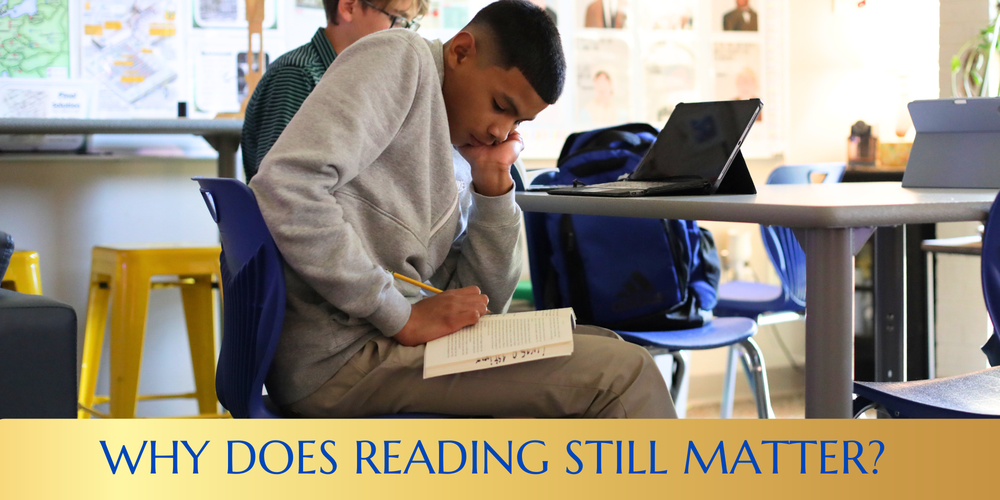
In an age of endless scrolling and bite-sized content, the simple act of reading a book can feel almost revolutionary. But what makes reading so valuable, and how can we foster a genuine love of literature across all ages?
For this special feature, we’ve gathered insights from four of our school’s most passionate advocates for reading. Each brings a unique perspective shaped by their work with different age groups and their own deep relationship with books. From the earliest picture books that spark imagination in our youngest learners to the complex narratives that challenge our older Spartans, these educators understand how reading shapes minds, builds empathy, and opens doors to worlds beyond our own.
Our contributors don’t just talk about the importance of reading - they live it. Each has shared not only their professional insights but also personal recommendations: books that have moved them, challenged them, or simply provided the kind of pure enjoyment that reminds us why we fell in love with reading in the first place. Whether you’re looking to rediscover your own reading habit or seeking the perfect book to inspire a young reader in your life, you’ll find thoughtful suggestions ahead.
In the pages that follow, our experts explore what reading offers at every stage of development, and why, despite all the competing demands on our attention, it remains one of the most valuable gifts we can give ourselves and our students.
Lindsey Ralston - 6th Grade Literature Teacher
Why do I read? That’s simple - it’s fun and cathartic! Readers read primarily for pleasure, however the positive impacts of reading are immeasurable and important. I recently came across this quote by Ralph Waldo Emerson, “I cannot remember the books I’ve read any more than the meals I have eaten; even so, they have made me.” Some books stick with us for years or even decades and others seep into our pores, yet the details escape our memory. Nonetheless, not too dissimilar from our relationships and life experiences, books can deeply enrich and impact the human experience.
Reading can bring joy and delight, build our vocabulary and knowledge, and keep the aging mind sharp. In my opinion, the best thing reading does is help readers become more empathetic and thoughtful about the world and people around us. It is cliche to say, but books truly are windows and mirrors. When books serve as a mirror, they allow readers to see themselves in a story, which can help us feel less alone or even understand ourselves better. When books are windows, they transport readers into the lives of people who may be very different from us, providing a wider world view. Furthermore, in an increasingly online world (and with dismal and dropping literacy rates in our nation), reading has started to feel like a wholesome rebellion against cultural trends. Being part of a reading rebellion by reading with my students and daughters (and by myself) is what drives many sacred moments in my days. I relish the fact that so many adults and children in the Collegiate community are also defying societal norms by spending their time with their nose (or ears) in a book!
Patti Yetter - EC & LS Librarian
As the librarian for Early Childhood, Lower School and Middle School, the minute details of my job change depending on the age group. The all-encompassing takeaways I hope for each and every student that becomes one of mine, however, stay the same, no matter the age group. I hope and pray that they fall in love with, if not reading, then at least one book; that my students know the best stories are ones that make us laugh and cry. I want the students exposed to such a wide variety of authors and illustrators and genres and writing styles that choosing “one favorite book” becomes impossible; that they see the beauty of the written words on the pages and imagine themselves as part of the illustrations; that years from now, when they hear mention of a specific book title or an author or illustrator’s name, the child will remember where they were when they heard or read that story. When the students physically leave me, I want them to go carrying books, both physically and figuratively, against their hearts. That is my hope.
Jillian King - 9th Grade English Teacher
As I often say in the classroom, literature is empathy personified. Reading allows us to step into another person’s consciousness, experiencing their thoughts, feelings, and motivations from the inside. For young readers, reading fiction can provide the ability to understand that others have their own unique perspectives. The stories we read serve as a point of access for understanding other people’s lives, thus helping individuals to build an internal library of human experience. Outside of the classroom, this internal library can be called upon to help students with developing observational skills, for instance, inferring a character’s motivations can help us to understand the emotions of real people. This new understanding then encourages compassionate behavior. Beyond that, emotional engagement can lead to greater enjoyment in literature. When readers use their imagination and interpret complex characters and themes, we actively co-create the scene we are reading about in our own minds.
More than anything, reading affords us the opportunity to slow down in a fast paced world. When we slow down and take a breath, we can experience the language and the metaphors on the page. And this type of deep, critical, and emotional engagement with a text is what strengthens the empathetic response. The act of reading allows us to step away from mindlessly binging content, and instead, we can take the time to reflect and wrestle with unfamiliar perspectives. I never settle for a student’s response when they say, “I don’t like to read.” Instead, my response is, “You haven’t yet discovered what you like to read.” As humans, we are often on a journey to discover what texts resonate with us, and what evokes an emotional response in us as readers. Those of us who love to read are simply on the path to discover the next great book!
Lisa Harris - K-4 Reading Specialist
Reading has always been an important part of my life, but not always an easy one. As a child, I struggled to read and didn’t always enjoy it. That’s one of the reasons I love being a reading specialist today. I understand how it feels when reading doesn’t come easily, and I’m passionate about helping students see that reading is a skill we learn, not one we’re born knowing.
Humans naturally learn to speak, but reading requires our brains to make brand-new connections. I like to remind students that every brain is like a fingerprint, completely unique. No two develop in the same way, and that’s perfectly okay! Your reading ability doesn’t measure how smart you are. Many brilliant inventors, musicians, athletes, and artists have struggled to read, yet they used their unique gifts to change the world. I find great inspiration in that truth.
When I was young, I loved Dr. Seuss’ books for their silly rhymes and playful sounds. As an adult, I gravitate toward books that help me grow as a mom, wife, teacher, and friend. My hope for every student is that they find their kind of book, one that makes them laugh, imagine, and feel proud to call themselves a reader.
Recommended Reading:
JILLIAN KING'S RECOMMENDATIONS
These are actually my November book recommendations in my classroom. I call them “Books to Be Thankful For”. But really, they are just some of my absolute favorite books.
Juliet by Anne Fortier
The Secret History by Donna Tartt
The Historian by Elizabeth Kostova
Circe by Madeline Miller
The Forgotten Garden by Kate Morton (*My favorite author)
Rebecca by Daphne du Maurier
Lady Audley’s Secret by Mary Elizabeth Braddon
The Short Stories of F. Scott Fitzgerald
All the Light We Can Not See by Anthony Doerr
If you are also looking for some non-fiction recommendations:
Toughness by Jay Bilas
Atomic Habits by James Clear
The Captain Class by Sam Walker
Think Like a Warrior by Darrin Donnelly
LINDSEY RALSTON'S RECOMMENDATIONS
I enjoy all different types of books! For adults, if you want something contemplative and heavy, I recommend The Names by Florence Knapp. It’s easily the best book I’ve read this year. However, if you crave something light, try The Five-Star Weekend by Elin Hilderbrand before the TV adaptation starring Jennifer Garner comes out soon!
(I can’t wait to watch!!) My current favorite picture book is a brand new one, Humble Pie by Jory John. (I’ve been reading it to my 7-year-old daughter on repeat!) A crowd-pleasing middle grade novel that I love is Faker by Gordon Korman. (My 10-year-old daughter and I both agree that Korman is one of the best middle grade authors!)
PATTI YETTER'S RECOMMENDATIONS
And what books do I believe EVERY child should have as part of their growing up? The list is long, but I abbreviated it to this:
Good Night, Moon by Margaret Wise Brown
Charlotte’s Web by E.B. White
The One and Only Ivan by Katherine Applegate
Piggie and Gerald books by Mo Willems
Mercy Watson series by Kate DiCamillo
Because of Winn-Dixie by Kate DiCamillo
The Snowy Day by Ezra Jack Keats
Robert McCloskey books and a sprinkle of Eric Carle and Leo Lionni because those books will never go out of style.
LISA HARRIS - Books I’ve enjoyed:
The Noticer by Andy Andrews
Reading in the Brain by Stanislas Dehaene
The One World School House by Salman Khan
Teach Like Your Hair’s on Fire by Rafe Esquith
Children’s books from authors who have dyslexia:
Captain Underpants and Dog Man by Dav Pilkey,
Thanks You, Mr. Falker by Patricia Polacco,
The Hank Zipzer series by Henry Winkler and Sally Gardner.
A few more children’s books I like:
Lady Lollipop by Dick King-Smith
On My Honor by Marion Dane Bauer
Out of My Mind by Sharon M. Daper